
Ernest Hemingway's A Clean Well-Lighted Place is set right after WWI. It's a simple story about an old man in a bar drinking late at night. It's also a story of despair and loneliness. The light in the story is significant in that the main character stays in the bar so he doesn't have to face the darkness. Throughout Hemingway speaks of nothingness: "It was all a nothing and a man was nothing too. It was only that and light was all it needed and a certain cleanliness and order. Some lived in it and never felt it but he knew it all was nada [nothing] y pues nana y nana y pues nada." The "it" is the unspeakable horror of war perhaps and the destruction of masculinity. The old man is seeming to say that there is nothing left in life, there is no meaning and nothing matters.
Hemingway actually served in WWI and became seriously injured. After the war, may soldiers came back with post-traumatic stress disorder, or shell shock. Take a look at this video:
The video above is one of the first depections we have of post-traumatic stress distorder. Freud called this hysteria. War is obviously still prevalent today with many people deal with this after being in Iraq and Afghanistan.
What do you think of this video? Do you think men that come back from serving have this same sense of nothingness in life?
Showing posts with label American Lit. Show all posts
Showing posts with label American Lit. Show all posts
Friday, July 3, 2009

Thursday, July 2, 2009
The Awakening - Kate Chopin
The Awakening was set during the late 1800s during the Victorian period. The main character, Edna Pontellier goes against the Victorian role of a woman in society in that she does not uphold the traditional image of a mother and wife. She finds herself at odds with the conventions of a culture that requires a woman to give up who she is to her family. She goes through a series of awakenings to what she really desires in life through art, love and music. Edna is actually a terrible mother - in one chaper her children are off gallavanting in the sea and she's not even paying attention! She also stops doing what her husband wants like staying home to greet visitors. Instead, she moves out of their massive home while he is away on business and tries to live the life of a bachelorette. Through exerting this independence and refusing to conform, Edna’s former self and former life begins to unravel leading to a life of unfortunate solitude.
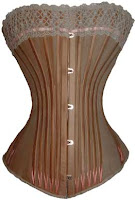
There are so many ideas to talk about along with this novel, but what I found most interesting were women's roles in society. Women in the Victorian era had very different fashions than women today. Corsets were popular - they were made like a cage which tightened around a woman's waist:
There are so many ideas to talk about along with this novel, but what I found most interesting were women's roles in society. Women in the Victorian era had very different fashions than women today. Corsets were popular - they were made like a cage which tightened around a woman's waist:
The corset is very similar looking to a bird cage I noticed. Not only were women caged by their clothing, but by their role in society. Birds are an important symbol in this novel and represent how women are trapped. We have come a long way since Edna's time... but have we?
How do you think women have changed since Edna's time? Do think gender stereotypes still exist and why? I'd love to hear what you have to say below!
Click here for some further reading on the Victorian Era.
Subscribe to:
Posts (Atom)
